
Table of Contents
Batch-Cooking Nutrition: How Freezer Organization Preserves Meal Quality
Batch cooking has become a routine habit for people who want to eat well without cooking from scratch every night, but the way those meals are frozen and stored can quietly undo much of that nutritional planning. For anyone who batch cooks regularly, batch cooking freezer organization is not just a matter of tidiness — it has a direct bearing on how much nutritional value survives the weeks a meal sits in storage. Freezing speed, how containers are arranged, and how easy it is to see what’s actually in the freezer all shape whether a meal keeps its vitamins and texture or slowly degrades in a forgotten corner. This article looks at how freezing habits and freezer layout influence nutrient retention in batch-cooked meals, and how a well-organized freezer setup supports healthier eating over time.
TL;DR — Key Takeaways
- Freezing meals quickly after cooking limits nutrient loss, since fast freezing forms smaller ice crystals that cause less damage to food cells than slow freezing.
- Vitamin C and several B vitamins are particularly sensitive to the delay between cooking and freezing.
- Poor batch cooking freezer organization leads to buried containers, freezer burn, and food that gets thrown out despite being technically edible.
- Searching for lost meals means longer freezer door openings, which cause temperature swings that can affect texture and nutrient stability.
- Visible, easy-to-access drawers and clear labeling with freeze dates make it easier to rotate meals before quality declines.
Why Freezing Speed Matters for Nutrient Retention
How quickly a cooked meal freezes has a measurable effect on how many nutrients survive the process. When food freezes slowly, the water inside its cells has time to form large ice crystals. Those crystals expand and puncture cell walls, and once the food thaws, the ruptured cells leak fluid — along with water-soluble vitamins and some of the texture that made the dish appealing in the first place. Rapid freezing, by contrast, produces many small ice crystals rather than a few large ones, which causes far less structural damage and helps the food hold onto more of its original nutrient content when it’s eventually reheated.
Vitamin C and several B vitamins are especially vulnerable to this process, since they are water-soluble and easily lost through cell leakage or oxidation during the gap between cooking and freezing. A soup left to cool fully on the counter before freezing spends more time in a temperature zone where these nutrients continue to break down than one that’s cooled briefly and frozen while still reasonably warm-to-cool.
There’s a practical trade-off here worth noting. Cooling a large pot of stew all the way down before freezing feels safer, but it also stretches out the time nutrients are exposed to degradation. Dividing a big batch into smaller, shallower portions increases the surface area exposed to cold air, which helps each portion freeze through faster than one dense, deep container would. The shape and size of the container, in other words, matters almost as much as the freezer setting itself.
The Hidden Cost of a Disorganized Freezer
Food doesn’t need to spoil in the traditional sense to become waste — a freezer that’s hard to navigate creates its own kind of loss. When containers are stacked without any system, the meals at the back or bottom are the ones most likely to be forgotten. Once a container is buried behind newer additions, it can sit untouched for months, and by the time it resurfaces, freezer burn has usually set in.
Freezer burn happens when moisture at the surface of the food slowly escapes into the surrounding air, especially if a container isn’t sealed tightly or if the food has been exposed to fluctuating temperatures. That moisture loss dries out the exposed surface, leaving a grayish, leathery texture and a noticeably duller flavor. Some nutrient degradation accompanies this process as well, since the same oxidation that dulls flavor also affects fat-soluble compounds over long storage periods.
Disorganization also causes damage indirectly, through the search process itself. Digging through a packed freezer to find a specific container means the door stays open longer, letting warm air rush in. That warm air raises the temperature at the surface of nearby food just enough to partially soften the outer layer of ice, which then refreezes into larger, coarser crystals once the door closes — essentially repeating the same cell-damaging process that slow freezing causes in the first place, but in smaller repeated doses. A freezer that’s opened and searched frequently, in short, slowly re-creates the very problem that fast initial freezing was meant to avoid.
How Freezer Design Supports Better Meal Tracking
Freezer features that make contents visible without opening the door solve much of the search-and-forget problem at its root. Drawers with clear or semi-transparent fronts allow a quick glance to confirm what’s inside, which cuts down on both the time the door stays open and the likelihood that a container gets pushed to the back and lost. Being able to see what’s stored, rather than guessing, reduces the chance that food ends up forgotten and eventually wasted.
Smooth-running rail systems play a similar role from a different angle. Kitchen designs that integrate the built-in freezer directly into cabinetry typically include telescopic rails that let each drawer extend fully rather than sticking halfway. That full extension matters because a drawer that only opens partway leaves its back third effectively invisible, which is exactly where forgotten containers tend to accumulate. When a drawer glides all the way out, every container becomes visible and reachable in one motion, instead of requiring a hand to dig blindly toward the back.
These aren’t incidental extras bolted onto a repurposed cabinet — they’re structural choices built into how a fully integrated unit is laid out from the start, with drawer depth, rail travel, and front visibility treated as core design elements rather than afterthoughts. For a household that batch cooks regularly and cycles through dozens of containers a month, that difference between a drawer that opens a few inches and one that opens completely can be the difference between a meal that gets eaten on schedule and one that quietly turns into freezer burn six months later.
Building a Nutrient-Friendly Freezer Routine
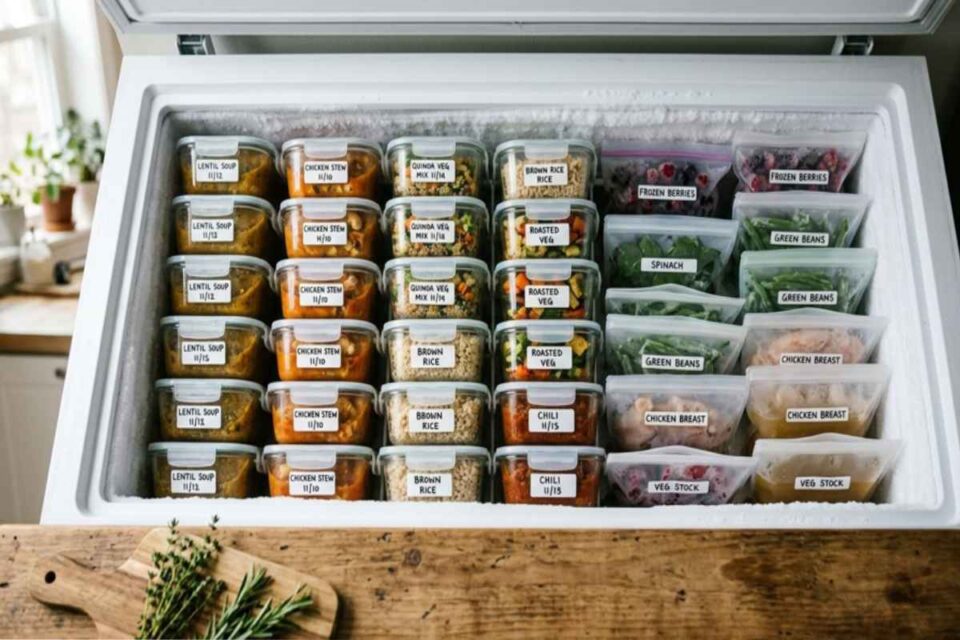
Good freezer habits work best when they combine speed and visibility rather than treating them as separate concerns. Labeling each container with the date it was frozen creates a simple, low-effort way to prioritize older meals before their quality declines further, since the goal is always to eat the oldest nutritionally sound meal first rather than reaching for whatever happens to sit at the front.
Portioning food into individual servings before freezing supports this same goal from another direction. Smaller portions freeze faster than one large block of the same dish, because there’s less mass at the center that needs to drop in temperature before the whole thing is solid. Faster freezing, as established earlier, means smaller ice crystals and less cell damage, so portioning does double duty: it speeds up the freezing process itself while also making it far easier to grab exactly the amount needed without thawing an entire batch just to eat one meal.
A rotation habit ties these pieces together. Placing newly frozen portions toward the back or bottom of a drawer, and moving older ones to the front, keeps the oldest meals in the most visible and accessible spot, which naturally encourages using them before quality drops any further. None of this requires elaborate systems — a marker, a set of same-sized containers, and a drawer arrangement that keeps meals visible cover most of what a batch-cooking routine needs to protect the nutritional effort that went into cooking the food in the first place.
Also Read: Best Affordable Hyaluronic Acid Serums