
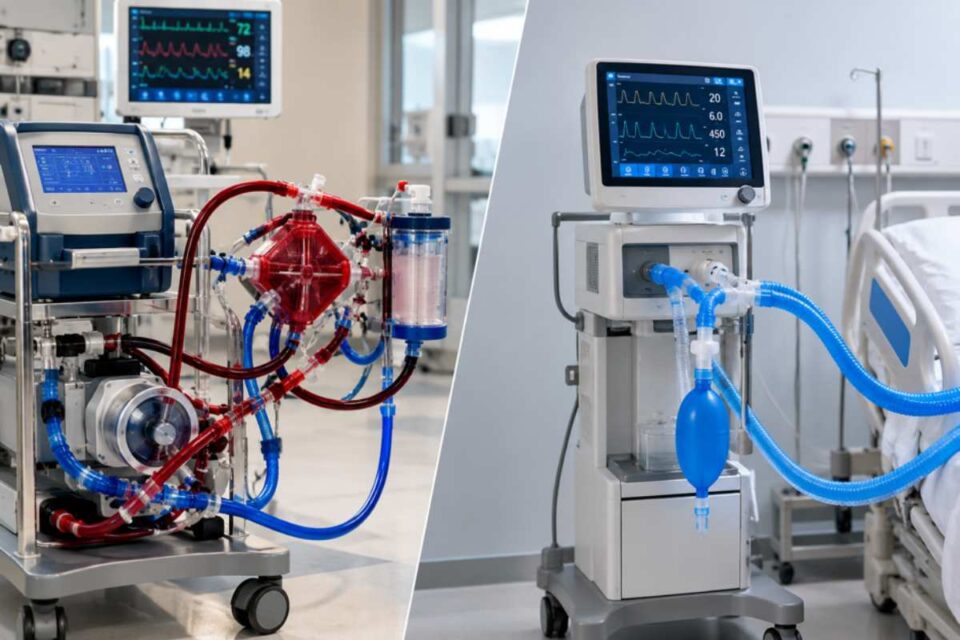
Families waiting outside an intensive care unit often hear unfamiliar terms in quick succession. One day the doctor says their relative has been put on a ventilator. A few days later, the team may mention ECMO. Both are described as “life support”, and in a stressful moment it is natural to assume they are the same thing, or that one is simply a stronger version of the other.
They are, in fact, quite different. A ventilator helps the lungs breathe. ECMO takes over the work of the lungs, and in some cases the heart as well, by oxygenating the blood outside the body. Understanding this difference helps families follow what the medical team is doing and why.
Table of Contents
What Is a Ventilator?
A ventilator is a machine that moves air and oxygen into and out of the lungs when a patient cannot breathe well enough on their own. In most ICU cases, a tube is placed through the mouth into the windpipe, a process called intubation, and the tube is connected to the ventilator. For patients who need support for a longer period, the tube may later be placed through a small opening in the neck, known as a tracheostomy. Some patients receive milder support through a tight-fitting face mask instead, which is called non-invasive ventilation.
The important point is that a ventilator only helps with the movement of air. The lungs themselves still have to do the actual work of passing oxygen into the blood and removing carbon dioxide. If the lungs are badly damaged, even the best ventilator settings may not be enough.
Ventilators are commonly used for:
- severe pneumonia and other serious lung infections
- acute respiratory distress syndrome (ARDS), where the lungs become inflamed and fill with fluid
- flare-ups of chronic lung diseases such as COPD
- patients who are unconscious, for example after a stroke or head injury, and cannot protect their airway
- during and after major surgery
What Is ECMO?
ECMO stands for extracorporeal membrane oxygenation. “Extracorporeal” simply means outside the body. Thin tubes called cannulas are placed in large blood vessels, usually in the neck or groin. Blood is drawn out through one tube, pumped through a machine with an artificial lung (the oxygenator) that adds oxygen and removes carbon dioxide, and then returned to the body through another tube.
In this way, ECMO does the job of the lungs directly, allowing badly damaged lungs to rest and heal. There are two main types:
- VV-ECMO (veno-venous): supports the lungs only. It is used when the heart is working well but the lungs have failed.
- VA-ECMO (veno-arterial): supports both the heart and the lungs. It is used when the heart is also failing, for example in severe heart attacks, serious heart muscle inflammation or after certain heart surgeries.
The Key Differences
- What it does: a ventilator pushes air into the lungs, while ECMO oxygenates the blood outside the body and bypasses the lungs.
- Dependence on the lungs: a ventilator needs the lungs to still work to some degree. ECMO can support a patient even when the lungs are barely working.
- Heart support: a ventilator does not support the heart. VA-ECMO can take over the work of both the heart and the lungs.
- How common it is: ventilators are widely used in ICUs. ECMO is a specialised therapy, offered at centres with a trained team and the necessary equipment.
- Order of use: a ventilator is usually tried first. ECMO is generally considered when a patient is not improving despite maximum ventilator support.
Many patients on ECMO also remain connected to a ventilator. In such cases, the ventilator is set to gentle, low settings, sometimes described as “lung rest”, while ECMO does most of the work.
When Do Doctors Consider ECMO?
ECMO is not a first-line treatment. Doctors usually consider it when oxygen levels remain dangerously low, or carbon dioxide stays high, even with the ventilator at its highest safe settings. It may also be considered when the heart can no longer pump enough blood despite medicines.
Situations where ECMO may be used include:
- severe ARDS caused by pneumonia, influenza or other infections
- life-threatening heart failure or cardiogenic shock
- support after complex heart or lung surgery
- as a bridge for patients waiting for a heart or lung transplant
It is important for families to know that ECMO does not cure the underlying illness. It buys time, supporting the body while treatment works and the lungs or heart recover. Patients are carefully assessed before starting ECMO, because the chances of benefit depend on the cause of the illness, how long the patient has been unwell and their overall health.
Risks to Be Aware Of
Both forms of support are life-saving, but neither is free of risk.
For patients on a ventilator, the main concerns are lung infections linked to the breathing tube, injury to the lungs from pressure, and the effects of the sedation needed to keep patients comfortable. Long periods on a ventilator can also lead to muscle weakness.
ECMO carries additional risks because it involves large tubes in major blood vessels and requires blood-thinning medicines. These risks include bleeding, blood clots, infection at the tube sites and, rarely, problems with blood flow to a leg. This is why patients on ECMO are monitored around the clock by a specialised team that may include intensivists, cardiac surgeons, perfusionists and trained ICU nurses.
Coming Off Support
As the patient improves, support is reduced step by step. For ECMO, the team gradually lowers the machine’s settings to check whether the heart and lungs can manage on their own before the tubes are removed. For a ventilator, a process called weaning involves short trials of breathing with less support until the patient can breathe independently.
Recovery after a long ICU stay often continues for weeks or months. Physiotherapy, breathing exercises and nutrition play an important role in helping patients regain strength.
Understanding the Care Plan
For families, the most useful step is to ask the ICU team clear questions: what type of support their relative is on, why it has been chosen, what the team expects in the coming days and what signs of progress they are looking for. Knowing whether a patient is on a ventilator, ECMO or both makes these conversations far easier to follow.
Advanced respiratory support works best in a setting equipped for it. In Rajasthan, the critical care team at Apex Hospitals, Jaipur provides intensive care for patients with serious breathing and heart conditions.
Also Read: How to Evaluate a Skin Care Clinic in Bangalore: A Dermatologist-Backed Guide for Every Skin Concern