
A bowler raps the pads, the close fielders go up, and the umpire shakes his head. The captain and the bowler huddle for a few seconds, somebody makes a T with their hands, and a stadium full of people turns to look at the big screen.
The Decision Review System has become one of cricket’s most watched rituals. It is also one of its most misunderstood. Fans argue about umpire’s call, doubt the ball-tracking, and wonder why a ball that was clearly hitting the stumps somehow stays not out. Most of that confusion disappears once you see what each piece of technology does, and, just as importantly, what it was never designed to do.
Table of Contents
What DRS Is Actually For
DRS was first trialled in Test cricket in 2008 and gradually spread to every international format and most major leagues. Its purpose is narrower than many fans assume. It is not meant to re-umpire every delivery. It exists to catch clear errors: the thick inside edge given out lbw, the catch that bounced first, the no-ball nobody spotted in real time.
That design goal explains a lot of rules that otherwise seem strange. Teams get only a limited number of unsuccessful reviews per innings, and the exact number varies by format and competition. Players have about 15 seconds after the ball becomes dead to ask for one. And when the technology shows a decision that is too close to call with confidence, the original on-field decision stands. The system is built to fix mistakes, not to replace judgement.
The Tools on the Third Umpire’s Desk
When a review comes in, the third umpire works through a sequence of checks, and different questions call for different tools.
Replays and the front foot
Almost every review of a dismissal starts at the bowling crease. If the bowler overstepped, nothing else matters, because the batter cannot be out. In many competitions the third umpire now monitors front-foot no-balls on every delivery rather than waiting for a review to prompt the check.
Ball-tracking
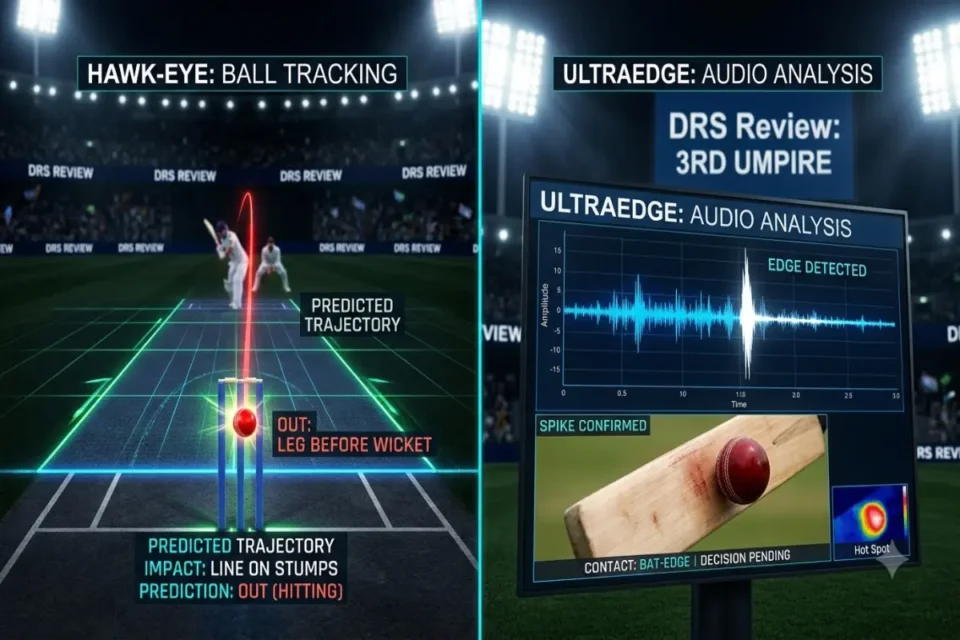
Ball-tracking systems such as Hawk-Eye use several high-speed cameras positioned around the ground. Each camera records the ball’s position many times a second, and software combines those images into a three-dimensional path. From there the system does two quite different jobs:
- It reconstructs where the ball actually went: where it pitched and where it struck the pad.
- It predicts where the ball would have gone next if the pad had not got in the way.
The first job is built on real observations. The second is a projection. That distinction sits at the heart of almost every argument about lbw reviews.
UltraEdge and Real-Time Snicko
To decide whether the bat touched the ball, the third umpire listens as well as looks. Sound-based edge detection syncs audio from the stump microphone with the video frames. A sharp spike on the waveform at the exact moment the ball passes the bat suggests contact. A spike a frame early or late, or a broad, flat noise, usually points to something else, such as the bat brushing the pad or scraping the ground.
Hot Spot
Some broadcasts also use infrared cameras. Friction from ball striking bat or glove creates a small heat signature that shows up as a bright mark on the image. Hot Spot is expensive to run and is not used in every series, and very faint edges can fail to register at all. That is a large part of why sound-based systems have become the more common tool.
How an LBW Review Is Decided
For a leg-before decision, ball-tracking answers three questions, always in the same order.
- Where did the ball pitch? If it pitched outside the line of leg stump, the batter cannot be out lbw, whatever happened afterwards.
- Where did it hit the pad? If the batter was playing a shot, the impact generally needs to be in line with the stumps. If no shot was offered, an impact outside off stump can still be out.
- Would it have gone on to hit the stumps? The projected path must be heading into the wicket.
The second and third questions are where umpire’s call comes in.
Umpire’s Call, Without the Anger
Umpire’s call is probably the most argued-over phrase in modern cricket, yet it follows a simple logic.
Ball-tracking is very accurate, but it is not perfect, and the prediction part carries a small margin of error. So the system asks a specific question: is the evidence strong enough to overturn what the on-field umpire saw with their own eyes?
On the question of hitting the stumps, the ball has to be projected to strike them with at least half of the ball inside a defined zone for a decision to be overturned. That zone runs across the width of the stumps and up to the top of the bails. The ICC raised the upper limit from the bottom of the bails to the top in 2020. If less than half the ball falls inside the zone, the evidence is treated as inconclusive.
That creates the result fans find maddening. The same projected path can end up out if the on-field umpire gave it out, and not out if they gave it not out. Both outcomes are the system working exactly as designed. It defers to the human whenever the machine is not confident enough to disagree.
Since 2017, teams no longer lose a review when an lbw decision stands because of umpire’s call. That change removed much of the sting, because a marginal call no longer costs a side the chance to correct a genuine howler later in the innings.
Why Reviews Get Wasted
Watch enough cricket and a pattern emerges. Reviews tend to be burned in a handful of predictable ways:
- Hope over evidence. A bowler convinced it was plumb persuades a captain who did not have a clear view from mid-off.
- The pad-first illusion. From the field, a ball hitting pad and bat almost together looks like a clean lbw. Sound and slow motion often reveal bat first.
- Forgetting where it pitched. Deliveries pitching outside leg kill many reviews before the impact even gets examined.
- Late-innings desperation. With one review left and a partnership building, captains gamble on marginal calls.
Wicketkeepers usually have the best view of line and length, which is why so many captains glance at the keeper before signalling. The sides that review well treat each review as a scarce resource rather than a form of protest.
Beyond Dismissals: Wides, No-Balls and League Innovations
DRS has kept evolving. The IPL and the Women’s Premier League began allowing players to review wide and no-ball decisions from 2023. It sounds like a small change, but it matters a great deal at the death, where a single extra delivery or a free hit can swing a result.
Some leagues have also rethought how the review itself runs. In so-called smart replay setups, the TV umpire sits with the ball-tracking operators and receives camera feeds directly, rather than through the broadcast director. Fewer hand-offs between people mean faster, cleaner decisions, and viewers at home see more of the same angles the umpire is actually using.
What a Review Does to Everything Around It
A review is not just a pause in play. It changes the rhythm of the whole match.
Batters use the break to reset. Bowlers lose some of their momentum. Broadcasters fill the gap with replays, graphics and slow-motion edges. And for fans following live markets on a second screen, a review is the moment prices freeze. Exchange platforms suspend trading as soon as an appeal is referred, because the outcome is about to become known and any price quoted in the meantime would be stale. People who follow cricket through an online cricket ID see this first-hand: the market locks, the decision arrives, and trading reopens at a new level within seconds. Rules on real-money play differ between countries and have tightened considerably in India, so this is best understood as a feature of the modern viewing experience rather than a recommendation.
It also explains why DRS moments feel so tense to watch. For a few seconds everyone, from the players and commentators to the people watching the numbers, is waiting on exactly the same piece of evidence.
The Honest Limits of the Technology
DRS has made cricket fairer. It has not made it perfect, and it helps to be clear about where the edges are.
Frame rates still matter. A ball bowled at 140 km/h covers almost 39 metres every second. Even very fast cameras leave small gaps between frames, and the finest edges or closest catches can fall inside those gaps.
Sound can mislead. Bat on pad, bat on ground and bat on the batter’s own clothing all produce noise. The third umpire has to judge which sound belongs to which contact, sometimes from a waveform that shows two spikes close together.
The soft signal has gone, but judgement remains. The on-field umpire’s soft signal for catches was scrapped in 2023, so the third umpire now decides on the replay evidence alone. When that evidence is inconclusive, someone still has to make a call.
Prediction is still prediction. Ball-tracking cannot know about the delivery that would have kept low or turned sharply off a crack after striking the pad. It projects from what it saw up to the moment of impact.
Watching Reviews Like an Umpire
The next time the big screen lights up, try following the third umpire’s sequence instead of your instinct:
- Check the front foot first.
- Look for bat or glove before worrying about the stumps.
- For lbw, work through pitching, impact and wickets, in that order.
- When umpire’s call appears, remember what the original on-field decision was.
Watch that way and most “controversial” reviews turn out to be far less mysterious than they looked from the stands. The technology rarely gets things badly wrong. It simply answers a narrower question than the one the crowd was asking.